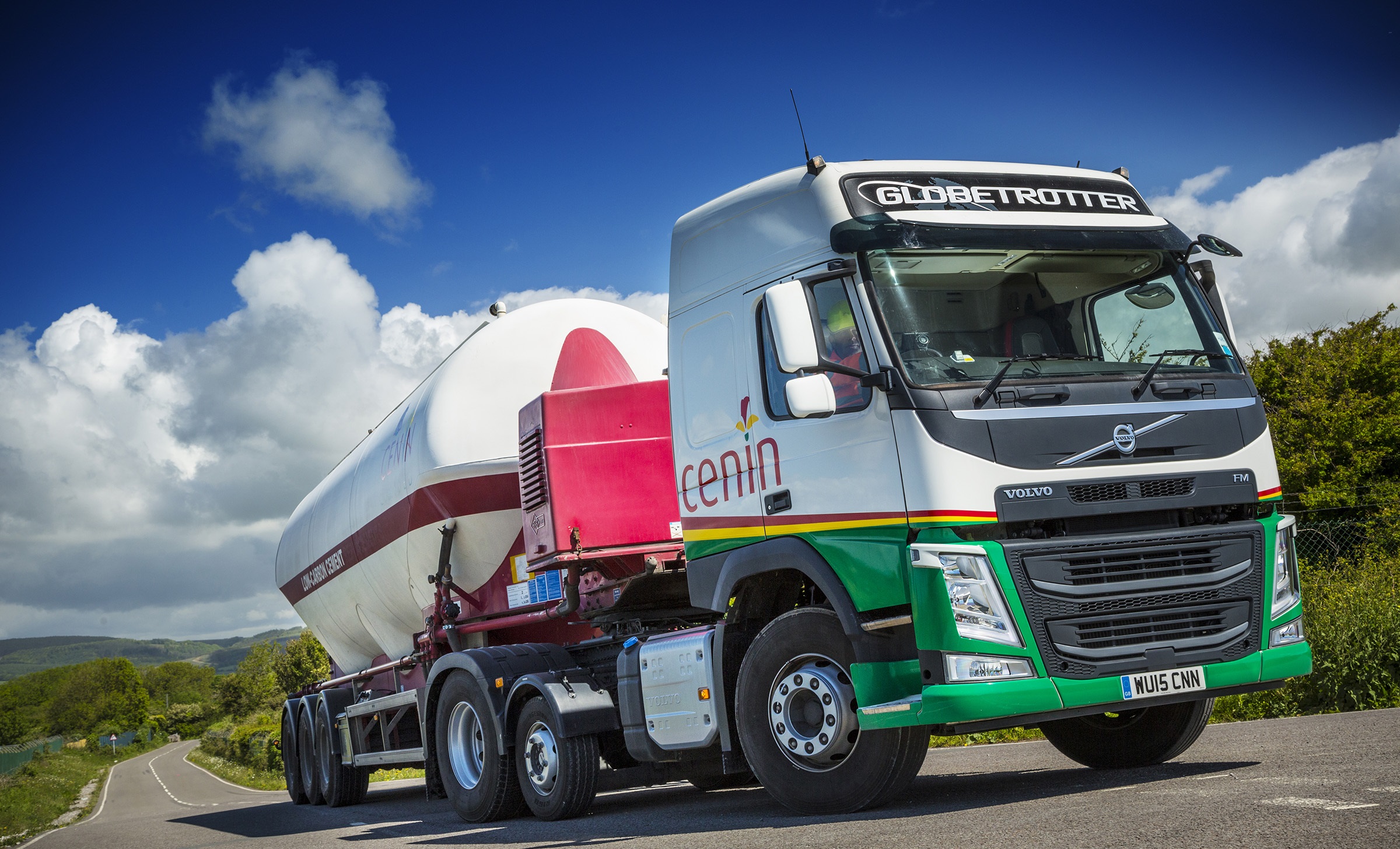
Cenin Cement has taken delivery of two Volvo FM 6×2 tractor units from Volvo Truck and Bus Wales & West in Avonmouth. The two Volvo trucks are the company’s first, having previously used a contract haulier. The investment decision was based with sustainability at the top of the agenda.
Cenin Cement is arguably one of the most environmentally-driven businesses in the global cement industry. Through the development of a unique process, the company uses industrial by-products, primarily from the steel and power industries, as the base material for production of a cement that features a very similar composition to traditional Portland cement. This innovation has enabled it to fundamentally reset the carbon footprint benchmark for an industry that is accountable for some 5% of the world’s carbon emissions.
“Conventional aggregate-based methods mean that for every tonne of manufactured cement approximately 920 kg of CO2 are produced,” says Technical Director Gary Hunt. “Here at Cenin Cement my patented process cuts that figure down to 48 kg of CO2 per tonne. Furthermore, through investment in green energy such as solar power here at Parc Stormy we have now reduced our emissions to 18 kg of CO2 per tonne of cement manufactured. We aim to cut this even further with the installation of a wind turbine in the coming months.”
A 98% reduction in carbon emissions is indicative of a company that, like Volvo, views the environment and sustainability as fundamental values. Production Manager, Phil Wellbeloved says: “It is all about the environment. If we can do things to help then we really should.”
With this in mind, the Cenin Cement directors had little hesitation in turning to Volvo when the decision was made to invest in its own trucks. “Volvo stood alone in meeting our ambitions in terms of our carbon footprint,” says Phil. “We chose the FM over the FH because it was that bit lighter, but still enabled us to increase our previous payload capability by 1.9 tonnes to 30 tonnes. The lightweight Estepe centre axle also helps payload potential of the 44 tonnes GCW trucks,” he adds.
Equipped with Globetrotter cabs, fridges and part-leather upholstery the two Volvo FM tractor units are powered by 6-cylinder Volvo D13K engines producing 500 bhp and 2,500 Nm of torque. They also feature the intelligent Volvo I-shift automated manual transmission.
“It was fascinating that when it came to recruiting drivers they appeared to be more interested in what truck they would be driving rather than the shift patterns or salary,” says Phil. “When I said it would be a Volvo their interest in the job simply intensified.”
The two FMs are expected to cover some 150,000 km/annum either collecting raw material or delivering cement. “It is all about sustainability and therefore we run a cyclical operation that means the Feldbinder bulk tanks being hauled by the Volvo FMs are always loaded,” he adds.
In their very first week on the run, the Volvo FMs impressed Phil in terms of fuel consumption. “With our old haulier we were getting about 7mpg, but with the Volvo FMs this has leapt up to as much as 9.8mpg. This represents a significant annual reduction in fuel usage and emissions, which again plays an important part in our sustainability ambitions.”
“Furthermore, the drivers are really impressed with the trucks. They have the power and comfort to perform and have reported back that the available torque in combination with the I-Shift transmission makes even the steepest gradients seem less punishing,” he added.
The FMs are on six-weekly ‘O’ licence inspections, which are being carried out at Volvo Truck and Bus Wales & West’s Newport dealership. “The team at Newport carry out inspections for us in the evening, which means our regular operations are completely unaffected,” says Phil. “This is real service and alongside the brilliant trucks and superb reliability puts Volvo in a league of its own. I am very happy that our sustainable business is moving forwards with Volvo in support.”