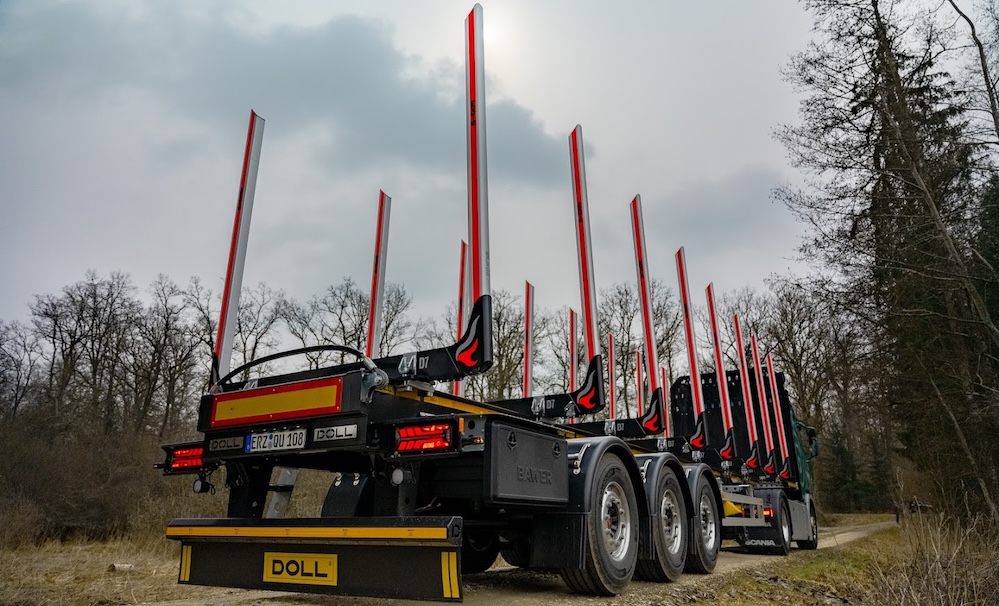
“The new LOGO 12 semi-trailer is much more than just a facelift,” says Daniel Spinner, Product Manager at DOLL TimTech. “We have rethought the entire vehicle concept and scrutinized every component, every connection, and every load situation down to the last detail. The result is a vehicle tailored to long-distance transportation, but which also shows its strengths in difficult terrain.” The semi-trailer is made of high-strength and durable fine-grained steel and has a low tare weight. Depending on the configuration, the vehicle is available from a weight of 5.3 tons and is therefore up to 15 percent lighter than its predecessor.
When redesigning the LOGO 12, DOLL paid particular attention to the frame construction. On rugged forest tracks riddled with deep potholes, in ruts and hairpin bends, and during tight turning maneuvers, the chassis is subjected to immense torsional stress. The two main beams of the frame were therefore additionally reinforced in the middle to absorb these stresses. FEM simulations were used to predict material behavior and load peaks in advance, enabling targeted optimization of the trailer during development. The reinforcement not only enhances off-road performance on challenging terrain, but also improves ride comfort, directional stability, and on-road handling. “The LOGO 12 proves that rugged durability, off-road capability, and lightweight design can go hand in hand,” says Stephan Gerber, Head of Development for Timber Vehicles at DOLL TimTech. “Innovative component geometries allow reduced sheet thickness at non-critical points and use of thicker material only where it is necessary.”
In addition to the frame construction, the DOLL engineers also redesigned the front wall completely. The four front wall supports are now bolted directly to the frame. The new, reinforced connection delivers greater stability and reduces vibration in the approx. 2.5 meter high component, especially off-road. “Hardly any other component is subjected to greater stress during timber transport than the front wall,” explains Gerber. “It has to absorb shocks during loading and withstand constant vibrations on forest roads.”